Catalogs & Pricing
Catch-weight, derived pricing, contract catalogs, customer-specific visibility. Your pricing is more complex than your platform. Confinus was built for it.
Book a Demo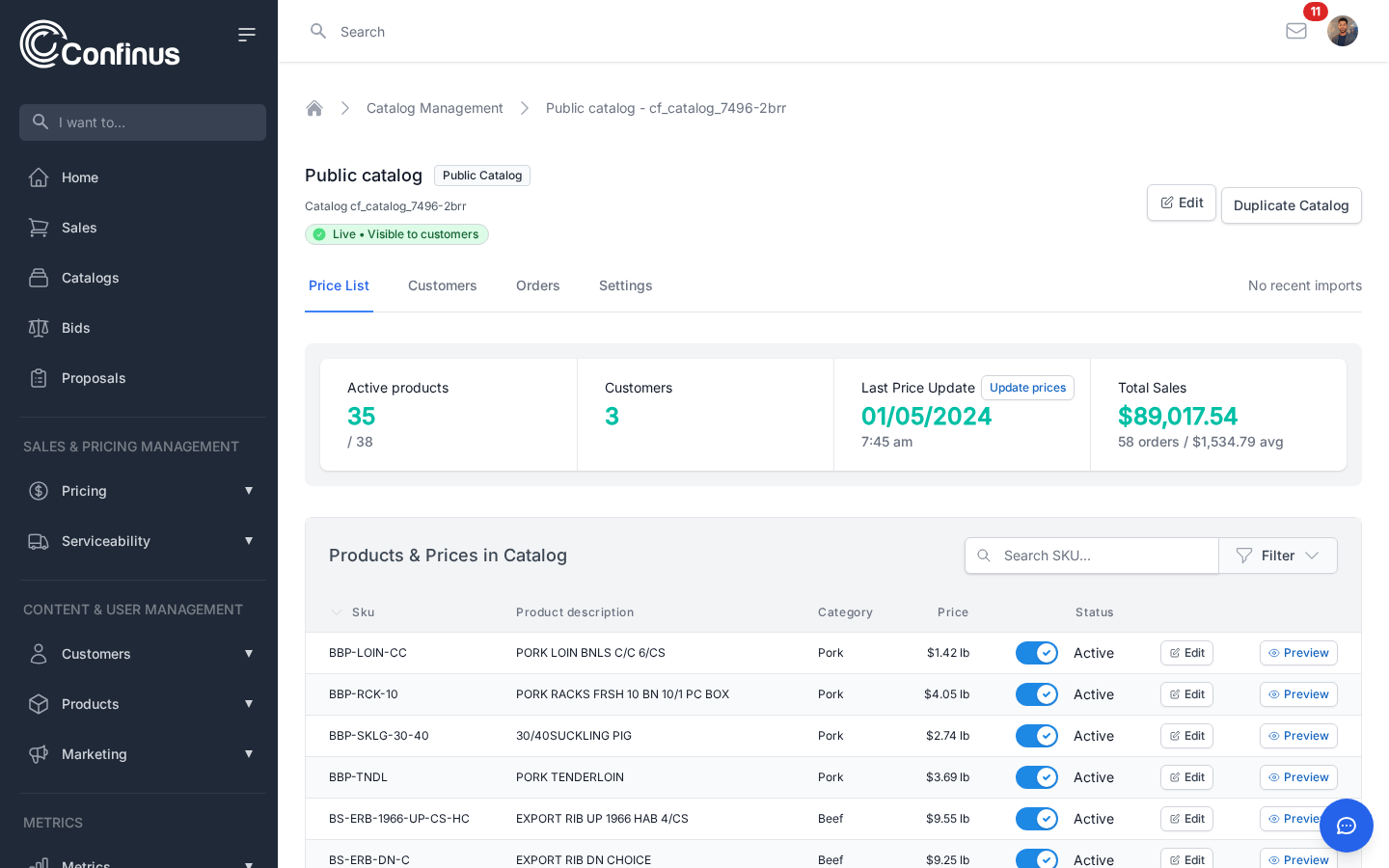
The daily reality of food distribution pricing
Chicken breast is up $0.12/lb. Four customer tiers, each priced differently, all in a spreadsheet. Update, recalculate, export, upload. Hope you didn’t miss a row.
Meanwhile, a case of avocados came in at 18.7 lbs instead of 20. The PO says $40. Your invoice says $37.40. AP flags it. Again.
This isn’t a technology problem you can solve with a better spreadsheet. It’s a modeling problem.
Product modeling that understands food
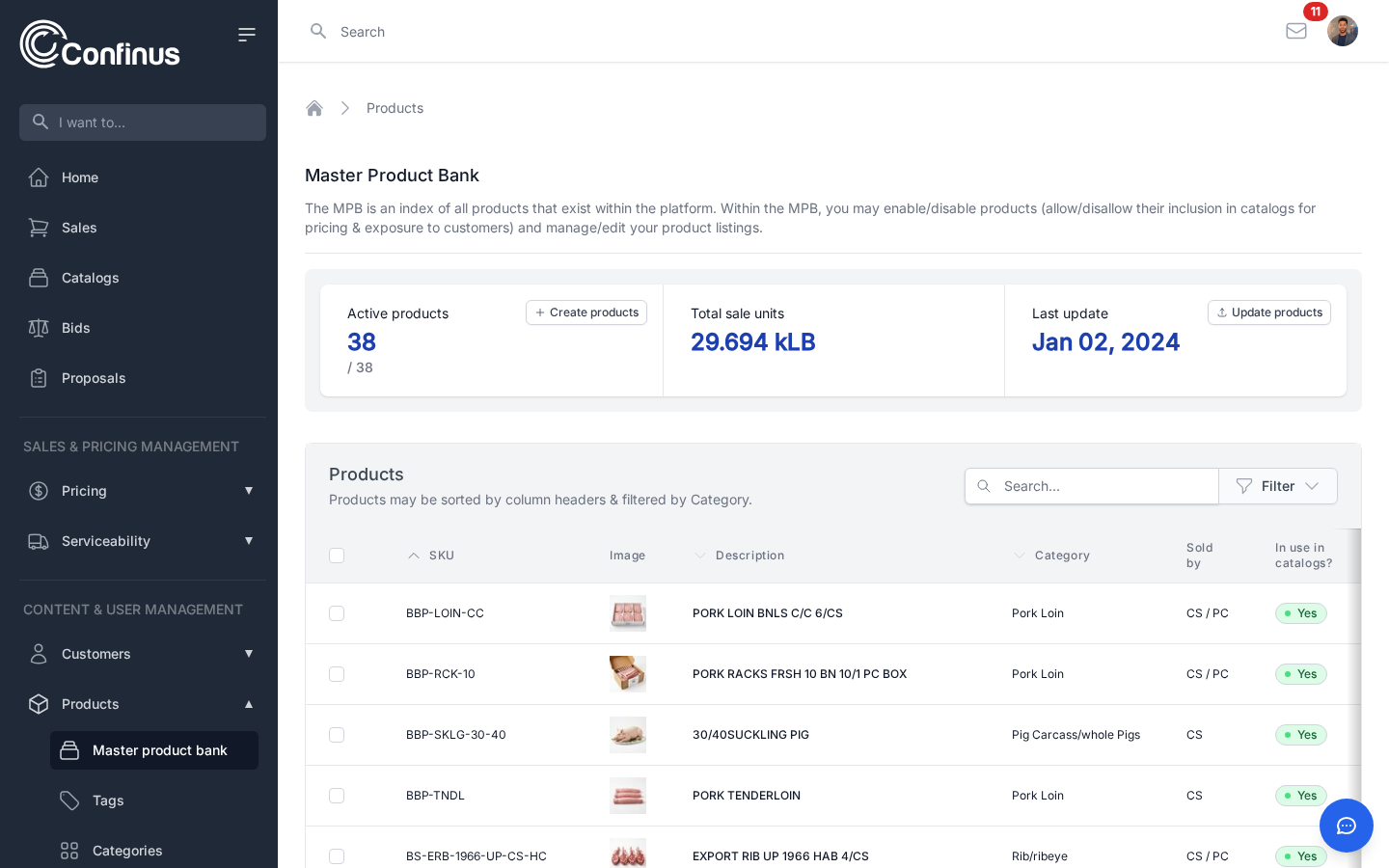
A name, a SKU, and a price isn’t enough. Food products have weight relationships, multiple UOMs, and prices that depend on what the scale reads.
- Catch-weight cascading. Mark a piece as catch weight; the case inherits it.
- Piece/case relationships. Define pieces per case and weight. The system computes the rest.
- Break case charges. Sell individual pieces with an automatic surcharge.
- Portioning. Set a portion size; the system calculates portions per case from the weight model.
- Multiple sell variants. One product sold by case, piece, pound, or portion — each with its own pricing.
Three products. Three different models. All handled natively.
Case of frozen fries
6 x 2.5 lb bags per case. Fixed weight. Priced by the case at a known weight. Simple — case in, case out.
Case weight: 15 lbs (fixed)
Sell by: Case
Price: $28.50/case
Case of ribeyes
4 pieces per case, ~12 lbs each, priced at $14.50/lb. Catch weight — case is ~48 lbs nominal but varies. Sell by case or by the piece. Buyers choose their portion size and see the price per piece and portions per case update in real time on the product page.
Case weight: ~48 lbs (variable)
Sell by: Case or piece (break case surcharge)
Price: $14.50/lb × actual weight
Portion: Buyer selects portion size → price per piece + portions per case update live
Crate of olive oil bottles
12 bottles per crate. Priced by the crate. The system knows the count and can show per-bottle cost automatically. Sell by crate or by the bottle.
Case count: 12 bottles
Sell by: Crate or bottle
Price: $84.00/crate → $7.00/bottle
Built for the way you actually price
You don’t have one price per product. You have a price hierarchy. Confinus models the full stack.
- Derived pricing. Cost + 15%. Or cost + $2.00/case. Create a derived catalog and the markup applies automatically. When supplier cost changes, every derived price updates instantly.
- Contract pricing. Fixed prices for specific customers and products. Locked down with permission controls — only authorised users can change a contracted rate. The derivation is fixed, not the cost.
- Customer-specific layers. List price, catalog-level overrides, customer-specific overrides. The system resolves the right price for every buyer, every product, every order.
- Proposals with time-bound pricing. Send a buyer a proposal with special pricing. It activates on the start date and expires on the end date. Managed through the bids and proposals system.
Three types of catalog. Use them together or independently.
List Price Catalog
Your default prices. The starting point. Every product has a list price here.
Derived Catalog
Inherits from the list catalog with a percentage or fixed markup. Cost + 12% for Customer A. Cost + $2/case for Customer B. When the base price changes, derived prices update automatically. Can also include specific price overrides.
Contract Catalog
Completely independent. Fixed prices for a specific customer — not derived from anything. Locked down so only authorised users can change them. The prices are what they are.
When chicken breast goes up $0.12/lb at 6am, every derived catalog updates automatically. Every contract catalog stays locked. Zero manual intervention.
Want to see this in action?
30 minutes. Your operation. No pitch deck.
Catalog management at scale
Who sees what, at what price, is a business decision you make per customer, per account, per location.
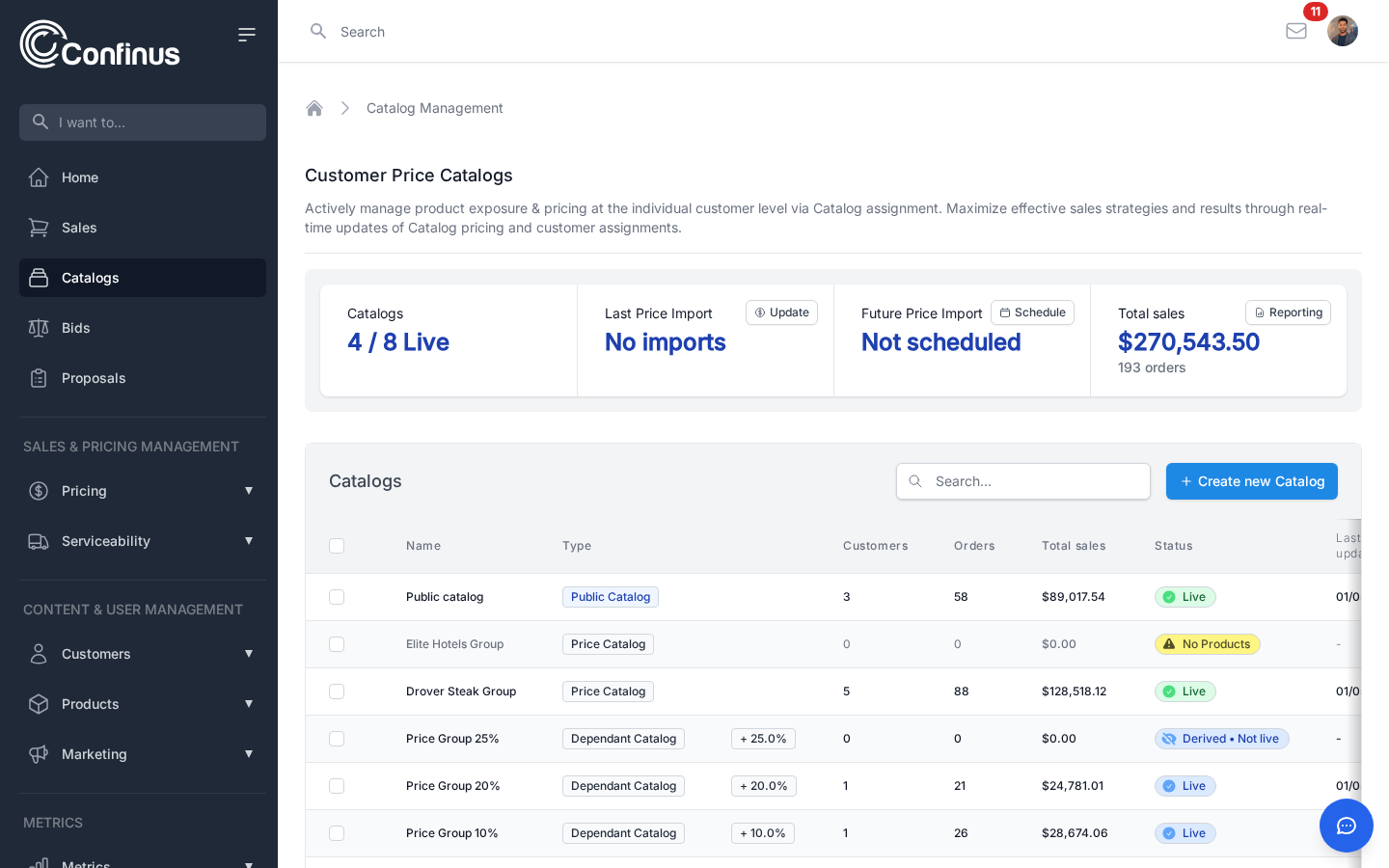
- Hierarchical catalogs. Base catalog with your full product line. Derived catalogs inherit what you don’t override. Changes cascade down.
- Visibility control. Products outside a buyer’s catalog don’t exist for them. Not frontend filtering — structural.
- Clone and customize. New customer looks like an existing one? Clone the catalog, adjust the 15 products that differ. Ten minutes.
- Bulk import. CSV, XLSX, or JSON. Schedule imports for future activation. Full import history.
- API-driven price updates. Push price changes from your ERP or internal systems via the REST API. Update thousands of prices at scale — your storefront reflects the new prices immediately.
The gap between generic and purpose-built
This isn’t a feature gap you close with configuration. It’s an architectural difference.
| Capability | Generic B2B Platform | Confinus |
|---|---|---|
| Catch-weight pricing | Not supported | Native, with piece-to-case cascading |
| Price by pound, sell by case | Manual workaround or separate SKU | Computed automatically from weight x price/lb |
| Break case charges | Not supported | Built-in surcharge logic |
| Cost-plus derived pricing | Spreadsheet, re-upload | Rules-based, auto-updating |
| Customer-specific price hierarchy | Separate price lists, manually maintained | Layered resolution: list → catalog → contract → customer |
| Catalog-controlled visibility | Tag-based filtering | Structural — products outside the catalog don’t exist |
| Catch-weight invoice accuracy | Manual adjustment post-order | Correct from the moment of order entry |
Ready to modernize your procurement?
See how Confinus can streamline ordering, catalogs, and delivery for your distribution business.
Not ready to talk? Take the 2-minute readiness assessment instead.